
%202.png?width=323&height=215&name=PH_VA_VR_Series_Technical_Support%20(1)%202.png)

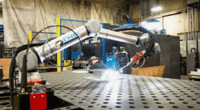
Collaborative Robots Transform Metalworking in the Age of Labor Shortages.
The metalworking industry is under increasing pressure. Rising customer demand, tighter production timelines, and growing quality expectations are colliding with a persistent labor shortage. Skilled welders are harder to find, and experienced tradespeople are retiring faster than new talent can replace them.
To stay competitive, manufacturers must rethink how work gets done. One of the most effective and accessible solutions is the adoption of collaborative robots (cobots), particularly those from Universal Robots (UR), to optimize welding and fabrication processes.
___________________________________________________________________________
Addressing Labor Shortages with Collaborative Welding
The metalworking industry is experiencing a persistent labor shortage, making it difficult to find skilled welders. With rising demand and a shrinking workforce, manufacturers must find innovative solutions to maintain productivity.
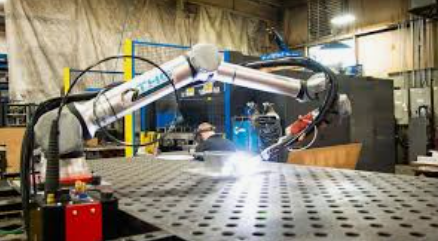
Collaborative robots (cobots) from Universal Robots offer a transformative approach. By automating welding processes, cobots help alleviate labor shortages while enabling employees to focus on higher-value tasks that require expertise and judgment.
Rather than replacing workers, cobots complement them—handling repetitive, physically demanding welds while skilled welders oversee quality, manage complex assemblies, and contribute to process improvements.
How Cobots Help Solve the Labor Crisis
Universal Robots’ cobots are designed to work safely alongside human operators. Their key advantages include:
-
-
Built-in safety features that allow close human collaboration
-
-
- Ease of programming, even for operators without robotics experience
- Quick deployment without expensive infrastructure changes
- Flexibility to adapt to short production runs or product variations
Unlike traditional industrial automation systems, UR cobots do not require large safety cages or complex reconfiguration.
This makes them ideal for small to mid-sized manufacturers who need scalable, cost-effective automation.
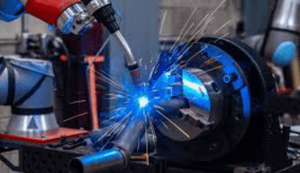
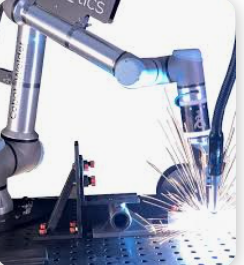
By automating repetitive welding tasks—such as MIG, TIG, or spot welding—manufacturers can:
-
-
-
-
-
-
-
-
-
-
-
-
-
-
- Reduce dependency on scarce manual labor
- Increase arc-on time and throughput
- Improve weld consistency and repeatability
- Minimize fatigue-related errors
- Reallocate skilled welders to higher-value activities
-
-
-
-
-
-
-
-
-
-
-
-
-
Employees can transition to roles in quality control, production planning, fixturing design, process optimization, and complex custom welding work—areas where human skill adds the most value.
________________________________________________________________________
Real-Life Examples:
Addressing Trained Welder Shortage & Boosting Throughput with Collaborative Robots
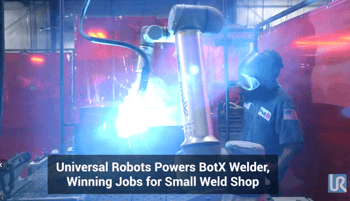
(WATCH VIDEO ABOVE: Weld Shop Addresses Trained Welder Shortage with Universal Robots Powered BotX Welder)
A mid-sized metal fabrication shop struggled to keep up with growing orders due to a lack of skilled welders. Production bottlenecks were increasing lead times, and manual welding inconsistencies led to costly rework.
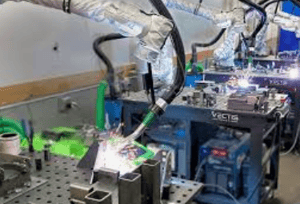
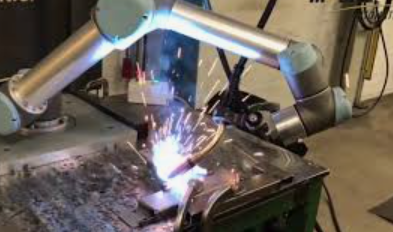
The company integrated a UR10e cobot from Universal Robots for MIG welding applications.
The results were transformative:
-
-
40% increase in welding throughput
-
Improved weld consistency
-
Reduced rework and scrap
-
Higher overall production efficiency
-
By assigning the UR10e to repetitive weld jobs, the company freed its experienced welders to focus on complex, high-precision projects. This not only enhanced product quality but also improved worker satisfaction—skilled tradespeople were able to apply their expertise where it mattered most.
Expanding Capabilities Beyond Labor Relief
The benefits extended far beyond simply filling labor gaps.
With improved productivity and consistent weld quality, the company expanded its service offerings to include:
-
-
Custom metal fabrication
-
Specialized welding applications
-
High-precision, small-batch production
-
This expansion helped attract new customers and positioned the company as an industry leader in high-precision welding solutions. By embracing automation, they achieved sustainable growth while maintaining the high-quality standards their reputation was built on.
Why Universal Robots for Metalworking?
Universal Robots cobots are particularly well-suited for welding and metalworking because they offer:
-
- Precise motion control for consistent weld paths
- Easy integration with welding equipment and positioners
- Compact footprints for crowded shop floors
- Rapid ROI compared to traditional robotic cells
Their collaborative nature also reduces the barrier to entry for automation, making it feasible for manufacturers that previously believed robotics was out of reach.
The Future of Metalworking is Collaborative
The labor shortage in welding and metal fabrication is unlikely to resolve itself. Manufacturers that wait risk falling behind competitors who are already optimizing operations through smart automation.
Collaborative robots are not just a stopgap—they are a strategic investment in operational resilience. By combining human expertise with robotic precision, metalworking companies can:
-
-
Stabilize production
-
Improve quality
-
Increase throughput
-
Expand services
-
Drive sustainable growth
-
In today’s competitive manufacturing environment, the most successful operations will not be fully automated or fully manual—they will be collaborative.
And with Universal Robots cobots, that future is already within reach.
Labor challenges aren’t slowing down, but neither is the pace of innovation.
The manufacturers who will lead the next era of metalworking aren’t simply those with more people or more machines, but those who best integrate both.
Collaborative robots offer a clear path forward: augmenting human skill, stabilizing operations, and unlocking new opportunities for growth.
The question is no longer whether to adopt automation
— it’s how quickly you can put it to work.
 ___________________________________________________________________
READY TO AUTOMATE WITH CONFIDENCE?
We are happy to HELP!
Whether you’re exploring your first robotic application, adding a component to your existing system, or upgrading a line with a new automation strategy, The Knotts Company can help you identify the right solution and products for your operation.
👉 Talk with a Knotts Automation Specialist TODAY!
Let's discuss automation solutions tailored to
YOUR manufacturing goals.
Our customized solutions highlight innovative technologies designed to help manufacturers improve performance and stay competitive.
From advanced automation and robotics to motion control and pneumatic systems, we deliver proven solutions that increase efficiency, enhance productivity, and support long-term growth.
Backed by deep industry expertise and personalized service, our team partners with you to implement the right solution for your unique application.
📩Automate@KnottsCo.com | 📞#(908) 464-4800