
%202.png?width=323&height=215&name=PH_VA_VR_Series_Technical_Support%20(1)%202.png)

In an industry where a millimeter can mean failure, collaborative robots are now redefining welding — turning human expertise into precision at scale.
In today’s competitive manufacturing landscape, metalworking operations are under constant pressure to deliver higher quality, faster turnaround times, and lower production costs.
Among the many advancements reshaping the industry, collaborative robots, commonly known as cobots, are emerging as a transformative solution, particularly in welding applications where precision is non-negotiable.
___________________________________________________________________________
The Critical Role of Precision in Welding
Precision is crucial in metal fabrication, especially in welding, where even minor inconsistencies can lead to defects, material waste, and costly rework. Traditional welding processes, heavily reliant on manual labor, often struggle with variability due to human fatigue, skill differences, and environmental factors.
This is where collaborative robots redefine the standard. Designed to work alongside human operators, cobots bring unmatched repeatability and control to welding tasks—ensuring consistent, high-quality output while improving overall operational efficiency.
How Cobots Improve Welding Precision
1. Consistent, High-Quality Welds
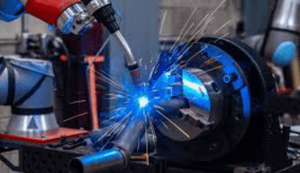
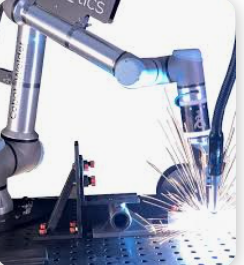
Unlike human welders, cobots do not experience fatigue or lapses in concentration. This allows them to maintain uniform welding parameters—such as speed, angle, and heat input—throughout production runs.
The result is a significant improvement in weld consistency and structural integrity.
-
-
-
-
-
-
-
-
-
-
-
-
-
-
2. Seamless Integration with Existing Equipment
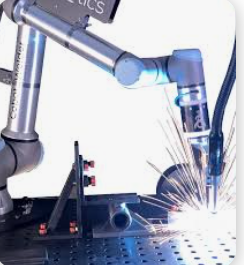
- Modern cobots, such as those from Universal Robots (UR),
-
-
-
-
-
-
-
-
-
-
-
-
-
are designed for flexibility.
They can be easily equipped with welding torches and integrated with existing manufacturing systems and software.
This enables manufacturers to enhance their current workflows without the need for a complete overhaul of infrastructure.
3. Reduced Material Waste
Errors in welding often lead to scrap, rework, and wasted materials. Cobots minimize these issues by executing precise, repeatable movements every time.
By reducing defects, manufacturers can lower scrap rates and significantly cut production costs. ___________________________________________________________________
Real-Life Impact: A Case Study
A structural steel manufacturer adopted a UR16e cobot for TIG welding of stainless steel components—a process that demands high precision and consistency.
The results were SUBSTANTIAL:
-
30% reduction in weld defects due to consistent motion and controlled heat input
-
20% increase in production speed, improving throughput without compromising quality
Beyond these measurable gains, the company also experienced a notable reduction in downtime caused by human error. With cobots ensuring that each weld met strict industry standards, the need for rework was drastically reduced.
This streamlined their quality assurance process and enabled faster turnaround times—allowing the manufacturer to meet growing customer demand without increasing labor costs.
Beyond Precision: Operational Efficiency Gains
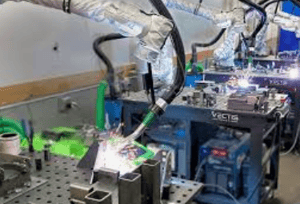
While improved accuracy is a major advantage, the benefits of cobots extend further:
-
Reduced Downtime: Automated consistency minimizes interruptions and production delays
-
Improved Workforce Utilization: Skilled welders can shift to higher-value tasks like inspection and programming
-
Scalability: Cobots can be quickly redeployed for different welding jobs, supporting flexible manufacturing
The Future of Welding in Metalworking
Collaborative robots are not replacing human welders—they are augmenting their capabilities. By handling repetitive, precision-critical tasks, cobots empower manufacturers to achieve a balance between automation and human expertise.
As demand for higher quality and faster production continues to rise, integrating cobots into welding operations is no longer just an innovation — it’s a strategic NECESSITY.
💡 Final Thought 💡
Optimizing metalworking operations requires more than incremental improvements —
it demands a shift toward smarter, more reliable technologies.
Collaborative robots offer a compelling solution by delivering precision, efficiency, and scalability in welding applications.
For manufacturers looking to stay competitive,
the message is clear:
THE FUTURE OF WELDING IS COLLABORATIVE!
 ___________________________________________________________________
READY TO AUTOMATE WITH CONFIDENCE?
We are happy to HELP!
Whether you’re exploring your first robotic application, adding a component to your existing system, or upgrading a line with a new automation strategy, The Knotts Company can help you identify the right solution and products for your operation.
👉 Talk with a Knotts Automation Specialist TODAY!
Let's discuss automation solutions tailored to
YOUR manufacturing goals.
Our customized solutions highlight innovative technologies designed to help manufacturers improve performance and stay competitive.
From advanced automation and robotics to motion control and pneumatic systems, we deliver proven solutions that increase efficiency, enhance productivity, and support long-term growth.
Backed by deep industry expertise and personalized service, our team partners with you to implement the right solution for your unique application.
📩Automate@KnottsCo.com | 📞#(908) 464-4800